How to Buy the Best Faux Fur Coat in the UK
Faux fur has quietly overtaken the real thing, and the best of it is very good indeed. Here is how to tell the good from the cheap before you spend.
The short answer
A good faux fur coat is judged on pile density, backing weight, and honest composition (modacrylic or a modacrylic-polyester blend). Expect to pay from around £60 for a decent cropped coat and £100 or more for full length. Anything sold as luxury for under £40 is almost certainly thin.
Why faux won
Fur farming has been banned in the UK since 2000, and importing or selling real fur now carries reputational and, increasingly, regulatory weight. That pushed the whole market toward faux, and the manufacturers followed the money: modern faux fur is denser, softer and more convincing than the stiff acrylic of a decade ago.
The result is that you no longer trade appearance for conscience. The best faux coats photograph like sable and cost a fraction of it. The only skill left to learn is telling a good one from a cheap one.
What quality faux fur actually is
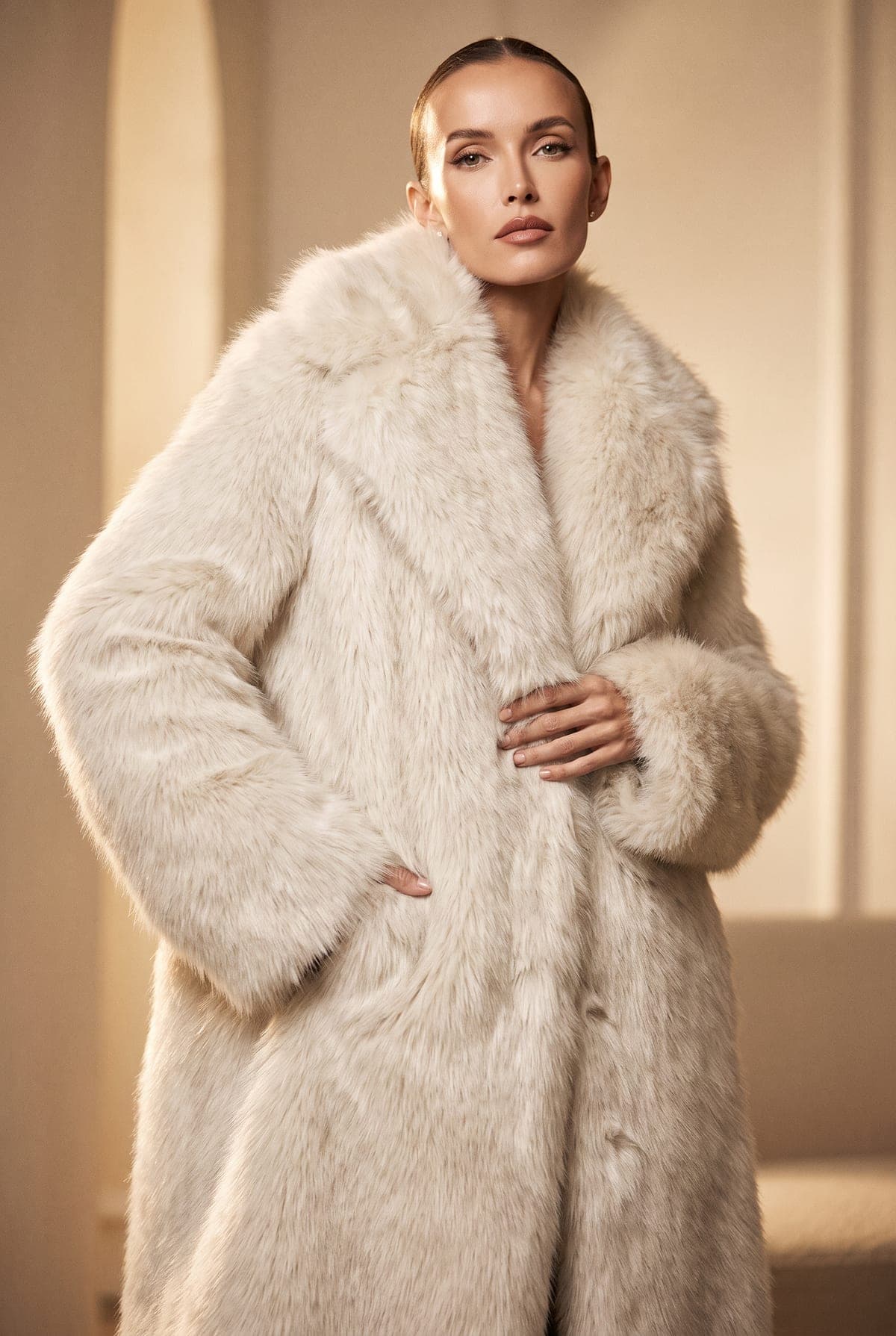
Look first at the pile: the length and density of the fibres. Good faux fur has a high, even pile with a soft undercoat beneath the longer guard hairs, exactly like the real thing. Cheap faux is sparse and shows its backing when you part it with a finger.
Then the backing itself. A quality coat has a woven or knitted backing with enough weight to hang and drape; a poor one is glued to a thin jersey that creases and sits flat. Finally, composition: the best synthetic fur is modacrylic, or a modacrylic and polyester blend. Pure polyester alone is warmer to the eye than to the touch.
Browse Full-Length CoatsView collectionThe silhouettes, and who they suit
Full length is the statement: a coat that finishes an outfit and turns a room. It flatters almost everyone because the vertical line lengthens. If you buy one faux fur coat, buy this one.
Cropped is the modern, everyday version. It sits at the hip, layers over tailoring and slip dresses alike, and reads younger and more casual. It is the coat you actually reach for on a cold Tuesday. Between the two, you have covered the whole winter.
Browse Cropped CoatsView collectionHow to spot a mislabelled real-fur coat
This matters more than most shoppers realise: cheap imports are sometimes real fur sold as faux, because rabbit or raccoon-dog fur can be cheaper to produce than good synthetic. Part the pile and look at the base. Faux fur grows from a woven fabric backing; real fur grows from skin, which looks like leather or suede at the root.
Second, the tips. Real hairs taper to a fine point; faux fibres are usually cut bluntly and are uniform in length. If a coat is suspiciously cheap and suspiciously convincing, check both before you buy. Every Orlava coat is faux by design and stated composition.
The Orlava way
We cut a small collection each winter, in genuine limited editions, and we tell you what each coat is made of. The Orlova is our full-length signature; the Palermo and Harlow are the cropped everyday pieces. All faux, all warmer than they look.

Quick answers
- How much should a good faux fur coat cost in the UK?
- From around £60 for a decent cropped coat and £100 or more for full length. Below £40, a coat sold as luxury is almost always thin-piled and glued to a light backing.
- What is the best material for a faux fur coat?
- Modacrylic, or a modacrylic and polyester blend. Modacrylic holds a dense, soft pile and resists heat better than pure acrylic or polyester alone.
- Is faux fur warm enough for a British winter?
- Yes. A dense faux pile traps air as effectively as many natural furs, and a good coat with a woven backing blocks wind well. Look for high pile density and a substantial backing.